In Conjunction with AACL-IJCNLP 2026

The Workshop on Multi-modality and Multi-lingual Language Learning

Harnessing technology to advance inclusive, multi-modal, and multilingual language learning for a connected world.

November 9, 2026co-located with AACL-IJCNLP 2026Hengqin, Zhuhai

Workshop Topic

Human communication is inherently multi-modal, combining spoken words, facial expressions, voice, body language, and visual context. Multi-lingual language learning helps bridge communication gaps in multicultural societies and supports more inclusive education.

This workshop focuses on multi-modality and multi-lingual language learning, including keynote and paper presentations as well as a shared task challenge. It aims to bring together researchers from NLP, computer vision, speech, education, and AI to investigate innovation in language learning for English, Chinese, and other low-resource languages.

Research on diverse languages promotes linguistic diversity, supports underrepresented learner populations, and yields insights applicable to education and everyday communication settings.

Call for Papers

We invite high-quality theoretical and experimental submissions on AI topics for language education and language learning.

Emerging Technology

Multi-modal and multi-lingual language learning systems, foundation models for education, and adaptive tools for diverse learners.

Evaluation

Benchmarks, diagnostic methods, shared-task systems, and evaluation frameworks for language learning technologies.

Learning Tools

Intelligent tutoring, feedback generation, writing support, grammar correction, and applications for real-world education.

Case Studies

Empirical studies on English, Chinese, low-resource languages, CFL learning, accessibility, and cross-linguistic transfer.

Submission:
Workshop paper submissions should be submitted to AACL-IJCNLP 2026 Workshop Multi-LLL.
ARR-reviewed paper submissions shall be committed through AACL-IJCNLP 2026 Workshop Multi-LLL ARR Commitment.

Timeline

Note: All deadlines are Anywhere on Earth (AoE).

Workshop Papers

  1. Call for papers
  2. Paper submission deadline
  3. Notification
  4. Camera-ready

Shared Task

  1. Training data release and call for participants
  2. Test data release
  3. Evaluation results announced by organizers
  4. System paper deadline
  5. Notification
  6. Camera-ready

Submission Guidelines

General Policy

The workshop is archivable, and its proceedings will be published in the ACL Anthology. All accepted and presented papers will appear in the workshop proceedings. At least one author of each accepted paper must register for the workshop and present the work at the hybrid 1-day event at AACL-IJCNLP 2026.

All submissions must follow ACL Policy on Publication Ethics, including ACL's Guidelines for Generative Assistance in Authorship. Dual submissions are not allowed. Submissions are editable, including authorship, until the deadline; no authorship changes are allowed after submission.

Manuscripts containing hallucinated citations, fabricated references, or unsupported factual claims may be desk-rejected. Authors are responsible for checking citations and references before submission.

Paper Submissions

The workshop solicits double-blind paper submissions on multi-modal and multilingual language learning. We welcome submissions in the form of research ideas, empirical studies, deployed systems, benchmark or evaluation papers, review papers, best-practice papers, and lessons learned from real-world applications.

Workshop paper submissions may be up to 8 pages in the main body, with unlimited but reasonable references and appendices. Papers must include a mandatory section on the Limitations of the Work, placed after the conclusions and before the references. Authors must also include a mandatory Declaration on Generative AI section in the paper. Authors may optionally include a section discussing ethical considerations and concerns regarding their research.

Submission Format

  1. Submissions are required to use the official ACL style template, available here. Please follow the paper formatting guidelines general to "*ACL" conferences available here. Authors may not modify these style files or use templates designed for other conferences.
  2. Each submission shall be one single PDF file, including the references and appendices.
  3. Supplementary materials of reasonable number and size may be included, but they are optional, and reviewers are not required to review these materials.
  4. Submissions that do not adhere to the specified styles, including paper size, font size restrictions, and margin width, will be desk-rejected.
  5. The reviewing process will be double-blind, wherein each paper will be reviewed by at least three reviewers. A meta-review will be provided in case of any disagreements. The final decision of acceptance/rejection will be made in consensus by the Chairs.

ARR Papers Resubmission

In addition to the workshop paper submissions specified in this CFP, we welcome resubmissions from ACL Rolling Review (ARR), as long as the topics are relevant to our workshop. Authors of papers that were submitted to ARR and have their meta review ready may submit their papers and reviews for consideration for the workshop by the ARR commitment deadline.

Authors can resubmit their reviewed papers from any previous 2026 ARR cycles. Reviewed and rejected submissions from ACL flagged conferences happening during 2026 and going through ARR 2026 cycles are welcome. Authors will be notified by the Notification of Acceptance date.

Submission Link

All submissions will be managed through OpenReview via dedicated submission websites:

Note: Please be aware of OpenReview's moderation policy when creating new profiles without an institutional email.

Presentation

All accepted papers shall be presented as oral presentations at the conference, either in-person or remotely.

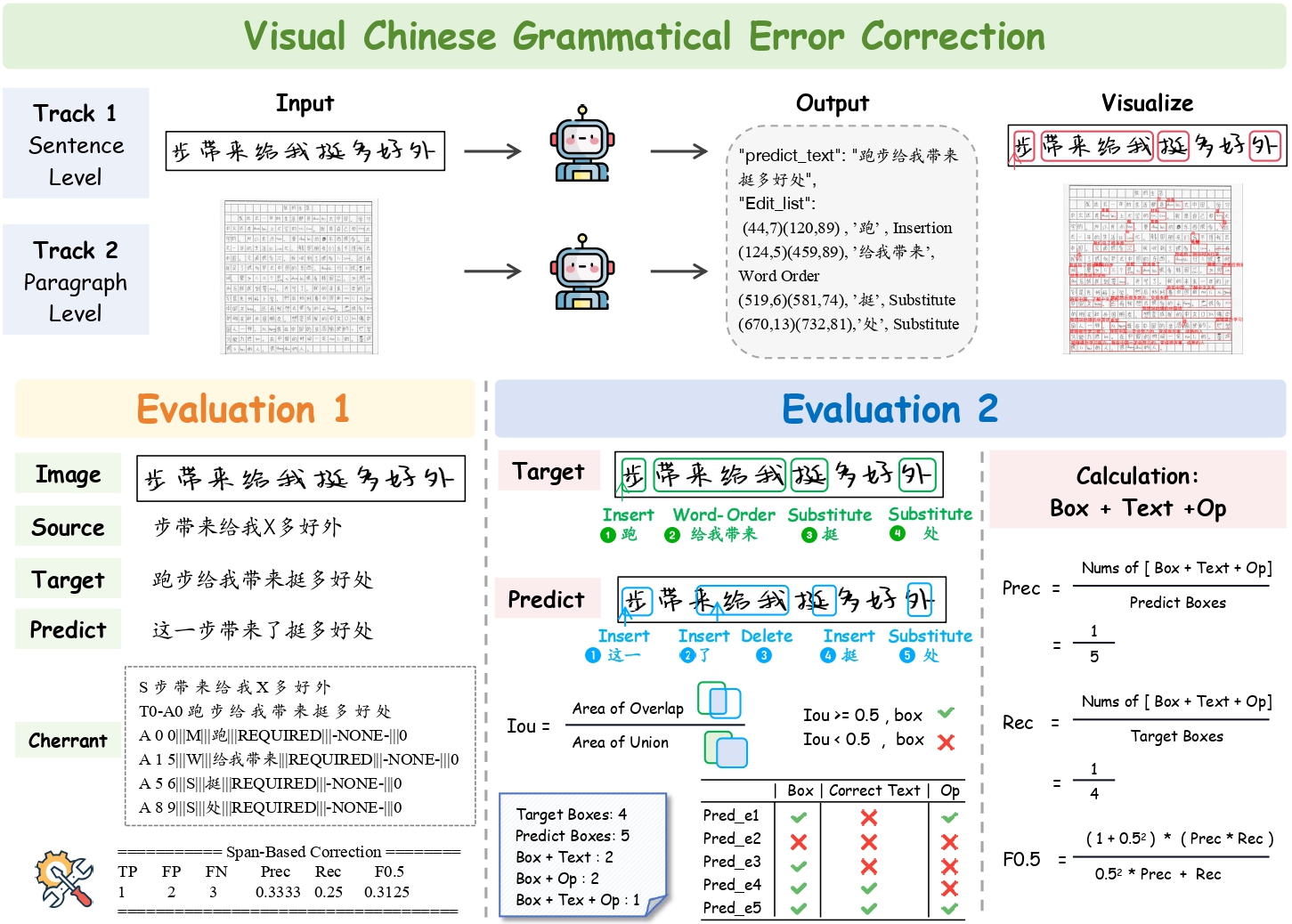
Shared Task: VisCGEC-v2.0

Shared task platform Tianchi Competition

Given an image of handwritten Chinese text, systems identify erroneous regions and produce linguistically correct revisions.

Overview of the Visual Chinese Grammatical Error Correction shared task

Tracks

  • Sentence-Level Track: single-sentence handwritten inputs and localized error correction.
  • Paragraph-Level Track: multi-sentence handwritten paragraphs requiring broader discourse context.

Dataset Statistics

Images Train Dev Test
Sentence-Level 1960 245 246
Paragraph-Level 350 - 88

The task will use complementary metrics, including sentence-level GEC evaluation and edit-level evaluation over bounding boxes, correction text, and edit type.

Participating teams are expected to submit a system report describing their methods, data use, model design, and evaluation results. Teams are also expected to present their systems at the workshop. System description papers accepted through the review process will be included in the workshop proceedings.

Tentative Keynote Speakers

More invited speakers are TBD.

Zitao Liu

Zitao Liu

Zitao Liu is the Dean of Guangdong Institute of Smart Education, Jinan University, Guangzhou, China. His research is in the area of machine learning, including artificial intelligence in education and educational data mining. He has published over 100 papers in highly ranked conference proceedings, such as NeurIPS, CVPR, AAAI, WWW, etc. and his applied research has resulted in more than 50 technology transfer and patents. Zitao serves as the Executive Committee of the International AI in Education Society, CCF Senior member and top tier AI conference/workshop organizers/program committees. He was the champions and runners-up of many competitions at top AI venues, including NeurIPS, EMNLP and Ubicomp.
More

He is a recipient of ACM and CCF Distinguished Speaker and Beijing Nova Program 2020. Before joining TAL, Zitao was a senior research scientist at Pinterest and received his Ph.D degree in Computer Science from University of Pittsburgh.

Zhongqing Wang

Zhongqing Wang

Zhongqing Wang is an Associate Professor at the School of Computer Science and Technology, Soochow University. His primary research interests span natural language processing, sentiment analysis, and information extraction. He has published over 50 papers in top-tier conferences and journals in AI and NLP. He currently leads and participates in multiple projects funded by the National Natural Science Foundation of China. He serves as a Senior Program Committee Member or Area Chair for prestigious international conferences including ACL, IJCAI, AAAI, EMNLP, and COLING.
Yinghui Li

Yinghui Li

Yinghui Li is a Senior Researcher at Tencent Youtu Lab. He received his B.Eng. and Ph.D. from Tsinghua University, and was a visiting scholar at the University of Illinois Chicago, working with Prof. Philip S. Yu. Dr. Li's research lies at the intersection of large language models, multimodal learning, multilingual language understanding, and AI evaluation. His work aims to develop and assess intelligent systems that can learn from heterogeneous information sources, reason across languages and modalities, and generalize reliably to complex real-world scenarios.
More

Dr. Li has published over 60 papers in leading venues such as ACM Computing Surveys, TKDE, ICML, ICLR, NeurIPS, SIGIR, ACL, AAAI, and EMNLP, receiving more than 3,000 citations on Google Scholar. His contributions have been recognized with multiple honors, including Outstanding Ph.D. Graduate of Beijing, the Best Paper Award at the AAAI 2025 Workshop, the SemEval 2023 Best System Paper Award, an ESI Highly Cited Paper, the Silver Medal at the International Exhibition of Inventions of Geneva, and several other academic awards.

Organizers

Xiaoman Wang

Xiaoman Wang

East China Normal University

Qianyu Wang

Qianyu Wang

East China Normal University

Zhengyuan Liu

Zhengyuan Liu

A*STAR, Singapore

Nancy F. Chen

Nancy F. Chen

A*STAR, Singapore

Zheng Yuan

Zheng Yuan

University of Sheffield

Yunshi Lan

Yunshi Lan

East China Normal University

Jing Jiang

Jing Jiang

Australian National University

Program Committee

  • Ahmed KarimHassana Labs
  • Andrew CainesUniversity of Cambridge
  • Bashar AlhafniMBZUAI
  • Chris J. BryantWriter Inc.
  • Chunyang WangEast China Normal University
  • David StrohmaierUniversity of Cambridge
  • Diana Galvan-SosaUniversity of Cambridge
  • Gabrielle GaudeauUniversity of Cambridge
  • Jiazheng LiKing's College London
  • Jing XuCambridge University Press & Assessment
  • Judy WangHosei University
  • Lei ShiNewcastle University
  • Luca BenedettoInstitut polytechnique de Paris & Telecom SudParis
  • Mariano FeliceBritish Council
  • Michael HofmeyrTokyo University of Science
  • Michael ZockAix-Marseille University
  • Michail KorakakisUniversity of Cambridge
  • Mingrui YeKing's College London
  • Nguyen LiNanyang Technological University
  • Robert SwierKindai University
  • Roman YangarberUniversity of Helsinki
  • Siya QiKing's College London
  • Stella Xin YinNanyang Technological University
  • Suchir SalhanUniversity of Cambridge
  • Thierry GeoffreUniversity of Luxembourg
  • Xuesong LuEast China Normal University
  • Yan WangEast China Normal University
  • Yuan GaoUniversity of Cambridge